Projects
These are some of the projects I have completed during my time at LSU.

BE 4390: Prosthetic Ears
My group and I designed an efficient, low-cost external ear prosthesis and streamlined a quick fabrication process. We scanned a patient’s ear using a 3D scanner, processed the images and created a 3D printed mold, scanned the patient’s skin with a spectrometer, dyed silicone to match the patient’s skin, and made adjustments to the final prosthesis as necessary. We worked with an ENT surgeon at Our Lady of the Lake in Baton Rouge. The doctor had us fabricate an ear for one of his patients for him to attach. The patient had some great feedback!
Team members: Emly Bracy, Olivia Henderson, Avery Olinde, and Cody Thompson

with Artec Space Spider Pro

designed in Artec Studio

from left to right: Avery, Emly, Ricki, Olivia, Cody
with Artec Space Spider Pro
ENGR 4103: Teleoperated AFO
My knowledge from Biomechanics lectures and my experiences from Magnolia innervated my term project for Assistive Robotics. My team and I designed a teleoperated ankle foot orthosis so drop-foot patients in rural areas or lacking transportation could receive adjustments in their home. The goal was for an orthotist to control the angle of flexion or extension of the AFO from an app on his phone while the patient remained at home. Although time proved to be a major constraint, we had a pseudo-working prototype!
Team members: Andrew Cihon and Samuel Gilliam


BE 4323: Biomechanics
In Biomechanics, I learned how to use foot force plates to analyze gait, measure impact and loading rates, and plot ground reaction forces and center of pressure. Most of the labs revolved around the engineering principles of the body and how our limbs and feet move. I was applying every lecture to what I learned at Magnolia Medical! As I began thinking about how what I learned in class could be applied to the clinic, I found myself gravitating more towards data analysis as a potential career path.

Electrodes placed on Emly's arm
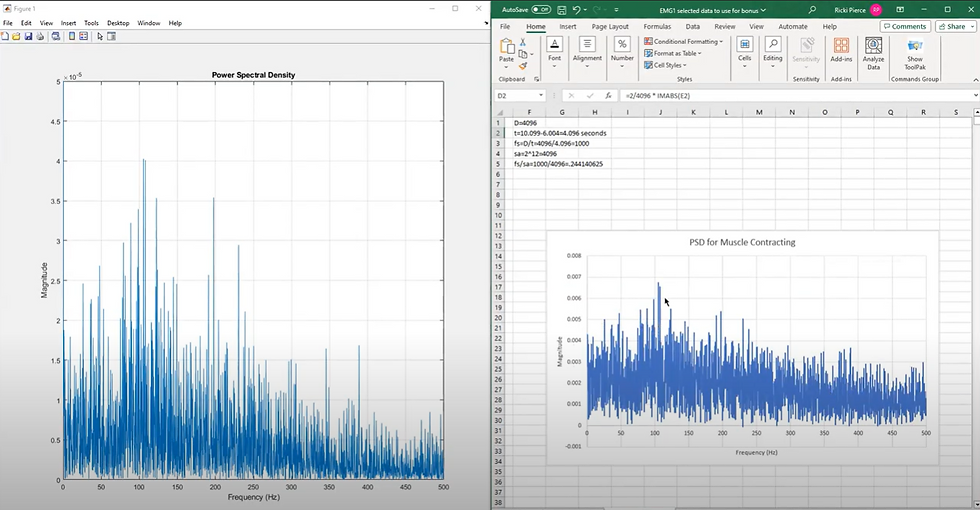
comparing results from MATLAB against Excel

my suggestion for a motion capture lab
Electrodes placed on Emly's arm


ME 4933: Computational Fluid Dynamics
In Computational Fluid Dynamics, I learned how to apply numerical methods and iterative techniques to solve complex fluid and heat transfer problems. Homework assignments explored foundational concepts like deriving second-order accurate estimates for derivatives using polynomial fitting. Projects involved solving heat conduction problems with varying material properties and exploring how thermal conductivity impacts temperature distribution using MATLAB. As I connected the classwork to real-world engineering challenges, I became more fascinated by numerical modeling and data analysis, solidifying my interest in pursuing biomechanics and design as career paths.
BE 3320: Dental Tool
In my Machine Design course, my team and I designed a rotary cutting dental tool given specific constraints and parameters. I developed the initial sketches and designs for the powertrain configuration, prioritizing simplicity for CAD modeling in SolidWorks. I performed force and stress analyses for bevel gears, coding calculations into MATLAB to automate and streamline the process. This included AGMA stress analysis for contact and bending stresses, which I adapted from coursework examples to suit bevel gears. I also conducted shaft stress analyses, applying the modified Goodman failure criteria to calculate safety factors. All calculations were validated by hand and automated in MATLAB to support efficient design iterations.
Team members: Emly Bracey, Chelsea Le, and Avery Olinde


BE 2350: UV Sensor
In Spring 2022, my team and I identified locations around Milford Wampold Memorial Park with high UV indexes (UVIs) as part of the University Lakes Restoration Project. A diverse population enjoys the lakes, although there are health risks associated with high UVIs. Utilizing UV sensors and Arduino code, we collected and processed raw data to generate UVIs, which was sent to Sasaki Engineering. They incorporated it into an environmental analysis report; phases of the restoration include improving safety in recreational areas.
Team members: Cailynn Gerald, Alyson Goree, and Jake Schexnaydre


Comparison of statistical significance among each pair of locations. Chart can be read from both directions.