Experiences

It’s amazing the circles we travel in. I first met Dr. Fears as a professor when I took Introduction to Motor Learning as part of my robotics minor in Spring 2024 (where my friend and I were the only engineers in a room full of kinesiology majors). Later, through biomechanics meetings I attended at the invitation of Nick Totaro (a Biological Engineering professor, employer, and mentor of mine), I reconnected with Dr. Fears. After learning about my master’s work in mechanical engineering, he invited me on a tour of his lab and facilities, and soon after, began the process of bringing me on as a research assistant. I am very grateful for the support of both Nicks: Nick Totaro for his mentorship and recommendations, and Dr. Fears for taking a chance on a student worker coming from outside his department.
Engineering Research Assistant
I am currently working under Dr. Nick Fears in the Human Development and Daily Life Lab within the Kinesiology Department, where my focus has been on developing technical tools to support motion analysis research.
I developed a cross-PC synchronization system linking Qualisys Track Manager (QTM) and Microsoft Media Player using Flask to automate motion capture recording and synchronized video playback. I then implemented inter-PC time synchronization and centralized event logging to generate unified experimental timestamps in Excel. I also calibrated three Optoma projectors with AutoBlend and PixelWix for projection mapping onto a curved display surrounding a Bertec split-belt treadmill with embedded force plates, wrote Python utilities for true full-screen rendering across the projection surface, and assisted in assembling the Bertec harness suspension system.
I designed and integrated a custom button-board system synchronized with QTM, auditory cueing, and Pupil Labs eye-tracking hardware. I fabricated the enclosure in Fusion 360, assembled LED push-button circuitry using an I2C breakout, and developed Python-based synchronization workflows integrating recording events, auditory stimuli, LED activation, and automated data saving through a GUI. Current work focuses on quantifying synchronization latency between QTM electrical triggers and Pupil Labs systems, including comparisons between hardware triggers and visually detected stimuli.
For Dr. Wan-Chun Su, I integrated Arduino-controlled buttons, force plates, EEG, fNIRS, and prospective Xsens IMUs. I modified Adafruit hardware with NeoPixels for independently controlled lighting patterns, designed custom enclosures in Fusion 360, and developed Python and Arduino software for randomized experimental protocols using strict timing and lighting patterns. I integrated trigger pipelines using LSL, LiveAmp EEG, Aurora fNIRS, and BrainVision Recorder, installed and configured the AMTI AccuSway force plate system, and have implemented automatic start/stop of the force plate data collection.

I assembled the harness suspension system and handrails onto the split belt treadmill


A single laptop running Python and Arduino code controls the button lighting patterns, synchronizes event markers to EEG (right side of table) and fNIRS (top of table) via LSL, automatically starts and stops force plate recording, timestamps button and force plate data, and saves all data files upon completion.
I assembled the harness suspension system and handrails onto the split belt treadmill
Biomechanist:
LSU & Ochsner
I worked with a markerless motion data capture system to analyze internal muscle forces and gait analysis. Having interviewed various CPOs in Baton Rouge and New Orleans, insurance directors, and an orthopedic surgeon, this technology would be of great use for patients trying to get their insurance companies to cover prosthetic and orthotic devices.
I have taken on a similar project at Ochsner's Therapy and Wellness Center in Baton Rouge. I was introduced to a state-of-the-art motion capture system, which collects a large amount of data. One of the physical therapists (who also has a doctorate in Electrical Engineering) asked me to write a code to analyze the data and present the results as graphs because to do everything manually cost him about seven hours. I spent a few weeks writing a MATLAB code and was successful in reducing this process to four minutes!

in LSU's iCORE lab


obtained after running OpenSim simulation and importing data into MATLAB to be analyzed
in LSU's iCORE lab
Biomechanic data analysis is where I’ve found my niche. Whether it’s to help get patients’ durable medical equipment approved by insurance or to help doctors and therapists make decisions about plans of care, I want to use my skills and knowledge to better patients' lives.
Magnolia Medical will always be a special part of my life as the clinicians and staff taught me that patients are more than just numbers - they're living proof that success is largely determined by one's own attitude, their support team, and the generosity and contributions of others.
I am deeply grateful for the trust Magnolia has placed in me, allowing me to contribute across so many areas. In return, I’ve been able to bring my own skills and creativity to the table. The relationship has been truly mutual: I’ve learned so much from them, and I’ve been able to give back in as many ways as I know how.
Magnolia Medical Intern
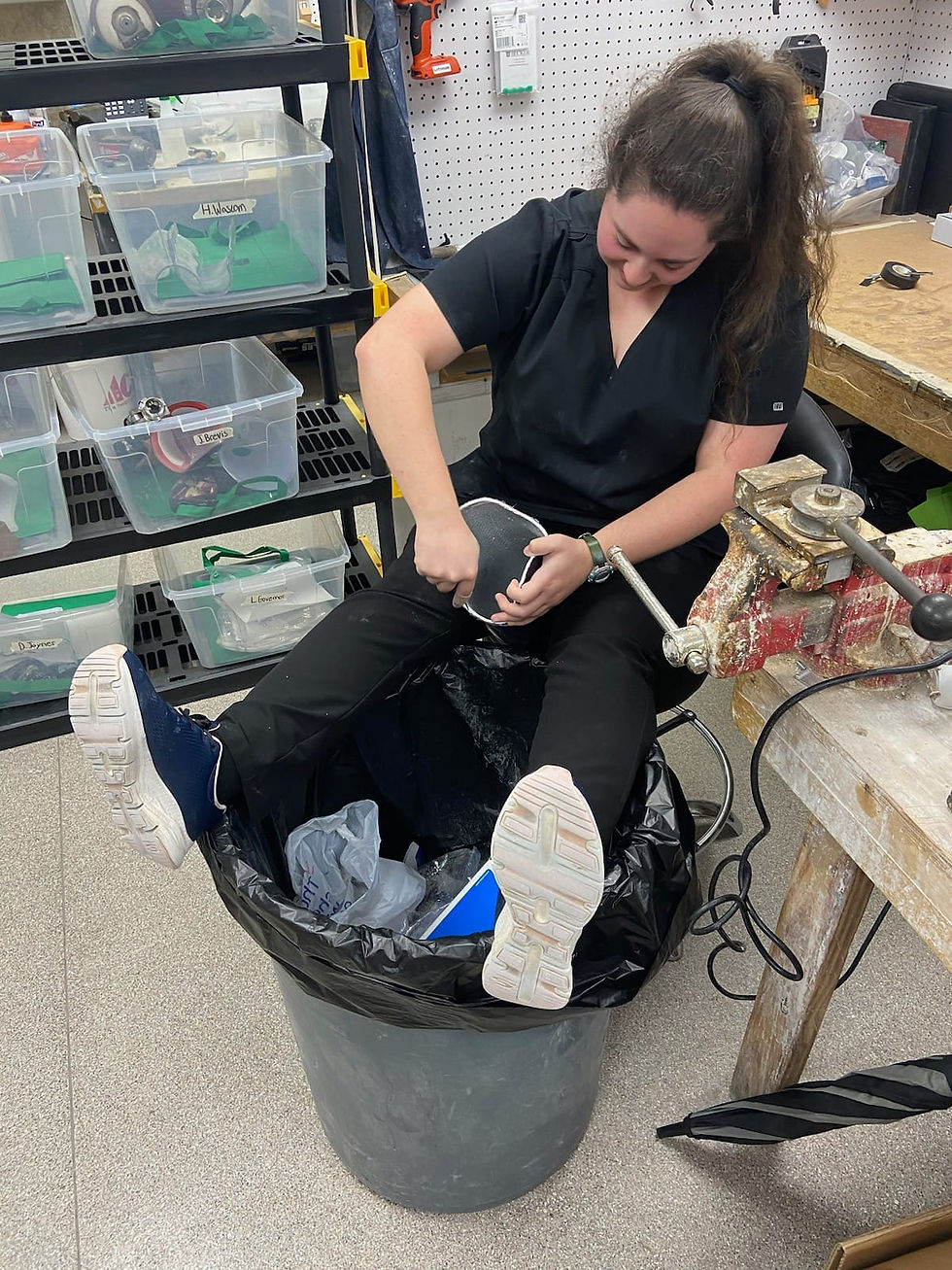
Since 2022, I have spent every summer interning at Magnolia Medical on Dijon Drive in Baton Rouge. During my first two summers, I learned how to fabricate limbs, modify molds, pull test sockets and inner liners, and write life plans. In 2024, my focus shifted to the administrative side, where I submitted authorizations for bone growth stimulators, monitored claims, resolved insurance issues, and maintained clear communication with both patients and insurers.
In 2025, I developed a successful case presentation for attorneys and HMR representatives, built an internal company website to centralize HR and insurance resources, and initiated the setup for government contracting. I was even asked to create Python scripts to generate commission reports for sales representatives covering products such as bone growth stimulators, back braces, and cervical collars.
The company even brought me to the Louisiana Orthotics and Prosthetics Conference in June 2023, May 2024, May 2025, and May 2026, where I attended seminars regarding new products and patient care. I was introduced to the various certified prosthetists and orthotists in Louisiana and made lots of great connections!


Ochsner Phlebotomist Specimen Processor
During the summer of 2021, I worked at Ochsner on Jefferson Highway in New Orleans. In the Pathology Department in the Benson Cancer Center, I checked specimens brought to the receiving window, stained slides corresponding to "frozen" specimens, reviewed and resolved problem cases, collected clinical and surgical specimen from within the hospital, recorded morgue and autopsy maintenance details, aided in discard of specimens, and added formalin to those specimens requiring it.
When a specimen would come through the window, I would research what it was, where in the body it was located, and why someone would need it removed. We received almost anything you could think of- we even had a few arms and legs come through the window! My fascination with the specimens sparked my interest in prosthetic attachments.

Germer, S. (2020). See inside Ochsner's Gayle and Tom Benson Cancer Center expansion. NOLA.com.
(Click image for source.)
If you'd like to read more about my work experiences, check out my resume!