Master's Progress
Following Spring 2026, Dr. Gilbert and I constructed the treadmill support platform in the machine shop. With support from Facilities Services, the completed structure was transported to the Kinesiology laboratory.
On May 28-29, 2026, I attended the Louisiana Orthotics and Prosthetics Conference (LAOP). Although I did not give a formal presentation, I had many discussions with clinicians, prosthetists, orthotists, and business owners about my research. The feedback I received was extremely valuable and encouraging, providing additional insight into the practical needs and challenges faced by the O&P community.
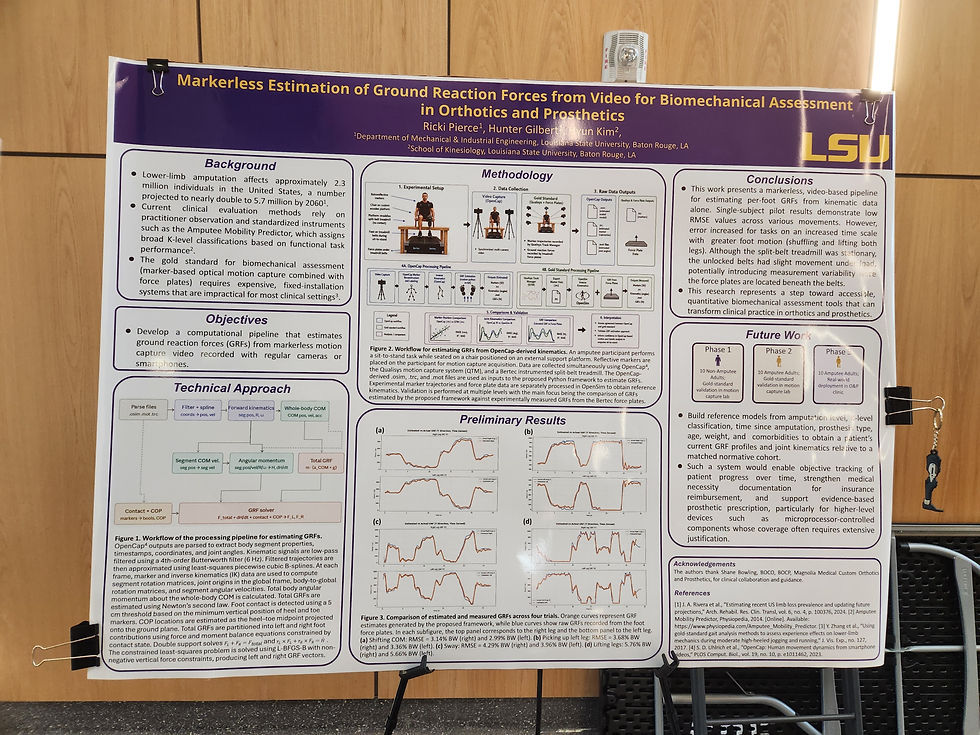
On May 30, 2026, I presented a poster showcasing my research and preliminary findings at LSU's Symposium on Control, Learning, and Intelligent Systems. Having just attended LAOP, I was able to share recent updates and perspectives from the O&P community with the engineering field.
On June 30, I had the opportunity to speak with Dr. Emily Miller, one of the driving forces behind OpenCap, which was especially exciting given the role OpenCap plays in my research.
I received IRB approval on June 17, 2026, and began testing participants on July 1. Over the summer, I collected data from 10 participants and developed analysis scripts to examine both entire movements and individual subsets of those movements. As is often the case with experimental research, I encountered several technological challenges along the way, which occasionally slowed the process. I am now analyzing the collected data, looking for recurring patterns, and investigating the sources of inconsistencies observed across participants and trials. I also spent a significant amount of time writing portions of my thesis.
I studied for, completed, and successfully passed my Qualifying Examinations in Dynamics, Controls, Vibrations, Statics, Strengths, Failure, and Math.
I also completed a little side project. Check out the Lagniappe page for more details!

Summer 2026

Left RMSE: 2.99% BW Right RMSE: 3.14% BW

Left RMSE: 3.36% BW Right RMSE: 3.68% BW

Left RMSE: 5.66% BW Right RMSE: 5.76% BW
Left RMSE: 2.99% BW Right RMSE: 3.14% BW
Spring 2026 marked a major transition from concept exploration
toward implementation and validation.
I enrolled in Mechanics of Biological Materials (Dr. Kevin Hoffseth),
Vibrations (Dr. Muhammad Wahab), and Motor Learning (Dr. Chris
Hill) while continuing development of custom algorithms designed
to generate accurate GRFs from OpenCap inputs.
Nick Totaro provided additional research support through loaned
equipment including tripods, calibration tools, and laboratory devices
needed for OpenCap data collection. Dr. Kim also provided full access
to the Kinesiology department’s motion capture systems and
instrumented split-belt treadmill.
Initial work successfully partitioned GRFs equally between limbs
while maintaining totals close to body weight, providing an early
verification step before moving toward accurate distribution estimation. The project then evolved into a non-zero moment balance framework. During development I realized accurate force estimation also required center of pressure estimation, leading to additional model refinements and parameter studies involving spline tuning and optimization strategies.
Pilot testing on myself produced unexpectedly strong early results: estimated GRFs frequently fell within 10% body-weight error, with many trials achieving under 5% error relative to measured values. With proof-of-concept results emerging, attention shifted toward IRB preparation. Multiple rounds of revisions were required as submissions were returned for modifications.
This semester also introduced a new experimental challenge. Because I was interested in sit-to-stand GRFs, placing a chair directly on the instrumented treadmill produced unusable measurements due to the added support loads. To solve this problem, I designed a raised platform surrounding the treadmill that supports chair loads independently while allowing only participant foot contact on the belts. After measuring the system, I drafted the design and sourced materials for fabrication.
I presented my work at the Graduate Student Research Conference and received 1st Place for Best Presentation. This was also the semester I began formal steps toward continuing into a PhD program.
Spring 2026
My second semester I enrolled in Advanced Biomechanics (Dr. Hyun Kim) and Advanced Dynamics (Dr. Hunter Gilbert).
Research efforts shifted toward methodology development for estimating GRFs from motion-derived information. One early concept involved projecting three-dimensional center of mass trajectories onto the ground plane to estimate load distribution patterns.
Using experimental data collected from the Biological Engineering Department's force plates, I began signal processing investigations involving spline fitting approaches and frequency filtering techniques. Data quality was difficult due to significant noise and hardware limitations, but these efforts established the initial processing pipeline.
During this period I also identified OpenSim APIs capable of tracking center of mass information for GRF estimation workflows. While promising conceptually, early results were extremely unreliable.
The OPF grant proposal was ultimately not funded. I applied to both the NSF Graduate Research Fellowship Program (GRFP) and the DoD NDSEG Fellowship.

Running Speed on Joint Angles, Moments, Muscle Forces, and Knee Joint Reaction Forces Using OpenSim’s Musculoskeletal Modeling

Joint reaction forces for the knee in the mediolateral, anterior-posterior, and vertical directions were calculated using joint reaction analysis averaged across subjects during the stance phase of running. Each plot shows results from the four running speeds (2, 3, 4, and 5m/s). All force data were normalized to body weight and are reported as multiples of body weight. In the ML direction, positive values indicate lateral forces. In the AP direction, positive values indicate anterior forces.
Running Speed on Joint Angles, Moments, Muscle Forces, and Knee Joint Reaction Forces Using OpenSim’s Musculoskeletal Modeling
Fall 2025
Summer 2025
During Summer 2025, I was invited to participate in a local biomechanics interest group organized by Nick Totaro that brought together faculty, clinicians, and researchers across the Baton Rouge area. Through this group I reconnected with Dr. Nick Fears in Kinesiology, whose interest in my motion capture background led to an introduction to the Kinesiology biomechanics laboratory.
Within the lab, I discovered their split-belt treadmill instrumented with embedded force plates. This was the validation environment I needed for my work.
Throughout the summer, Dr. Gilbert continued mentoring me in advanced dynamics concepts while we began developing custom computational tools from scratch. I attended Stanford’s Mobilize/OpenCap office hours, where discussions clarified how supplementary OpenCap scripts perform dynamic simulations using contact spheres placed on the feet and estimates forces through Hunt–Crossley contact models combined with friction and dissipative terms. I also attended the Louisiana Orthotics and Prosthetics (LAOP) annual conference where I discussed my ideas with professionals, clinicians, and O&P clinic owners and received some great feedback!
Spring 2025
My first semester of my master’s program focused on establishing
the technical and research foundations for my thesis work.
I enrolled in Image Processing (Dr. Kevin Hoffseth) and
Data-Driven Dynamics and Controls (Dr. Corina Barbalata) while
beginning my research under Dr. Hunter Gilbert.
Early efforts centered on understanding the current state of
amputee ground reaction force (GRF) research. I conducted an
extensive literature review with emphasis on datasets containing
clinically meaningful information, including level of amputation,
time since amputation, prosthesis usage history, socket and
suspension systems, and prosthetic foot types. This review revealed a
major gap: normative amputee datasets containing this level of detail
are extremely limited, largely reflecting the underrepresentation of amputee populations in biomechanics research.
At the same time, I began exploring computational biomechanics tools including OpenSim, Simbody, and Moco, while studying the OpenCap framework and manuscript. I started learning advanced dynamics concepts through regular meetings with Dr. Gilbert and began investigating how musculoskeletal simulation could support future GRF estimation methods.
Experimental validation would require force measurement systems. I began obtaining quotes from force plate manufacturers. Existing force plates within LSU's Biological Engineering department were aging systems that required annual shimming due to plate warping and unevenness.
I also explored OpenSim model structures and attempted to modify the default hierarchy to allow grounded foot interactions rather than the standard configuration where the pelvis remains fixed and the feet move freely through space. These attempts ultimately proved unsuccessful but provided valuable insight into model architecture limitations.
Toward the end of the semester, I identified funding opportunities through the Orthotics and Prosthetics Foundation (OPF) and wrote a grant proposal to support equipment acquisition for my research.

Panel showing original RGB image, landmark detection, landmarks connected, and bounding box from left to right. Notice this example does not include padding.

EDMD (extended dynamic mode decomposition) trained on all 12 cycles of data. Used to predict Trial 1 Cycle 1 data. Right and left arm rotation plotted showing real data recorded and EDMD prediction.
Panel showing original RGB image, landmark detection, landmarks connected, and bounding box from left to right. Notice this example does not include padding.